
Introduction
Hyper-casual games have been among the few successful genres in the mobile gaming arena and are enjoyed by millions because of their simplicity, accessibility, and addictive mechanics. As we move to the year 2025, it prompts the questions; what else would be the profitability or sustain gnosis of such kinds of games. Hyper-casual games: are they still a worthy cause for investment? In this article, we shall find out why hyper-casual remains a lucrative market, current trends, plus actionable insights for game developers who want to venture into this lucrative genre.
What Distinguishes Hyper-Casual Games from others?
The distinguishing characteristics of hyper-casual games encompass minimalist graphics design, straightforward mechanics, diverse appeal. Here is where separation becomes evident:
Design Simplicity: These games are stripped down to nothing, emphasizing one-tap or swipe mechanics-with everyone mastering them within seconds.
Mass Appeal: It has the widest possible audience, ranging from proper kids in adult terms.
Short Development Cycle: A developer might need weeks to develop and publish a hyper-casual game instead of waiting for months before the game gets completed.
The 2025 Market Landscape

The mobile gaming industry hitchhiked an unprecedented growth phenomenon with hyper-casual games serving a significant role in the increased growth of the industry. Here are some of the main trends in 2025.
Mobile Gaming Revenue- mobile gaming forecast to generate more than US$100 billion worldwide with a good share from hyper-casual games.
Global Reach- hyper-casual retails continue to attract emerging markets as a result of its low hardware requirements and free-to-play models.
Top Performers: Stack Ball 3D and Helix Jump She is still an inspiration for game developers as they top the app store charts.
Monetization Models of Hyper-Casual Games
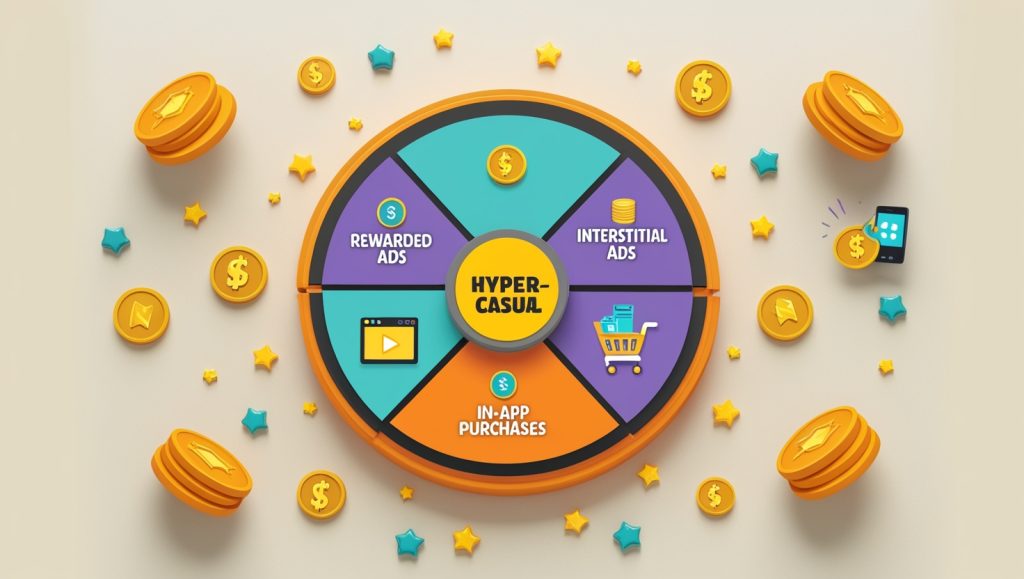
All hyper-casual games adopt their monetization strategies to meet the standards of making profit for the developers. Following are leading revenue streams:
- In-Game Advertising:
Rewarded advertisements will show to players (watch ads, gain in-game reward), and interstitial advertisements (appear between levels), and use banner ads at the non-intrusive static sections of the game screen.
- In-App Purchases:
Simply providing free cosmetic upgrades, extra lives, or ad-free consumption.
- Publisher Partnerships:
Making use of pub-funding, marketing, and wide distribution empires.
Reasons Developers Still Invest in Hyper-Casual Games
Hyper-casual is a low-risk, high-reward investment that has a continual attraction for developers. These are their reasons:
Less Cost of Development: Even with Unity and some other tools, all these can come from an indie source to build hyper-casual games without much investment.
Try Out: Developers can experiment with a lot of gameplay mechanics or points without high investment.
Artificial Intelligence tools: Emerging advanced AI tools in Unity can now allow faster prototype and play-test optimization.
Challenges and How to Overcome Them

While profitable, the hyper-casual genre isn’t without its challenges. Here’s how developers can tackle them:
Stay updated on popular themes, like AR integrations or seasonal trends.
1. Market Saturation:
Focus on unique, innovative gameplay mechanics.
Use analytics to understand player preferences and fine-tune your game.
2. Monetization vs. Player Experience:
Strike a balance between ads and gameplay to keep players engaged without frustration.
3. Keeping Up with Trends:
Stay updated on popular themes, like AR integrations or seasonal trends.
Advice for Game Developers

If you are planning to dip your toe in the hyper-casual game space, you can take a few actionable ideas:
Make use of the Unity tools: Unity has an asset store through which the user can get access to prefabricated templates and tools, which speed up the process of development.
Keep Focusing on Visuals: Great designs and smooth animations are fundamental in luring players.
Partner with Publishers: That way, you can have a much broader audience and funding.
Conclusion
By 2025, this sector will remain as profitable and vibrant-a category for developers-as it defines today in the context of hyper-casual games. With simplicity in design and its intimate transition narrative, broad appeal, and effective ways of monetization, it would surely stay in the hype of the mobile gaming arena. For a developer, the latest success recipe would involve creativity, an understanding of what players want, and of course, usage of development-friendly tools such as Unity.
Whether you’re indie or come from a big studio, hyper casual pretty much offers untapped potential for growth and income. Dive in, play around, and create your next hit!